

Hey there! I'm a supplier of High Efficiency IE3 Explosion - proof Motors, and today I wanna talk about how the speed control of these motors works.
First off, let's understand why speed control is so important for High Efficiency IE3 Explosion - proof Motors. In many industrial applications where these motors are used, like in oil and gas refineries, chemical plants, and coal mines, different processes require different motor speeds. For example, in a chemical mixing process, you might need a slow and steady speed at the beginning to gently blend the ingredients, and then increase the speed later for more thorough mixing. And of course, safety is a top priority in these explosive environments, so the speed control system has to be reliable and precise.
Now, let's dig into the main methods of speed control for these motors.
Variable Frequency Drive (VFD)
One of the most common and effective ways to control the speed of High Efficiency IE3 Explosion - proof Motors is by using a Variable Frequency Drive. A VFD is like a magic box that can change the frequency and voltage of the electrical power supplied to the motor.
You see, the speed of an AC motor is directly related to the frequency of the power supply. The formula for the synchronous speed of an AC motor is (N_s=\frac{120f}{P}), where (N_s) is the synchronous speed in revolutions per minute (RPM), (f) is the frequency of the power supply in Hertz (Hz), and (P) is the number of poles in the motor.
When you use a VFD, you can adjust the frequency. If you decrease the frequency, the motor speed will decrease, and if you increase the frequency, the motor speed will go up. For instance, if you have a motor with 4 poles and the power supply frequency is 50 Hz, the synchronous speed (N_s=\frac{120\times50}{4}=1500) RPM. If you use a VFD to change the frequency to 25 Hz, the new synchronous speed will be (N_s=\frac{120\times25}{4}=750) RPM.
The advantage of using a VFD for speed control is that it offers a wide range of speed adjustment. You can control the motor speed from almost zero to its rated speed. Also, VFDs can improve the energy efficiency of the motor. When the motor doesn't need to run at full speed, you can reduce the frequency and voltage, which means the motor consumes less power.
However, VFDs also have some drawbacks. They are relatively expensive, and they can generate harmonic currents, which might cause interference with other electrical equipment in the system.
Pole Changing
Another method of speed control is pole changing. In a motor, the number of poles determines its synchronous speed. By changing the number of poles, you can change the motor speed.
Some High Efficiency IE3 Explosion - proof Motors are designed with multiple sets of windings that can be connected in different ways to change the number of poles. For example, a motor can be designed to operate with 2 poles or 4 poles. When it operates with 2 poles, the synchronous speed will be higher compared to when it operates with 4 poles.
The main advantage of pole - changing speed control is that it's a simple and reliable method. There are no complex electronic components like in a VFD, so it's less likely to fail. But the downside is that you can only have a few discrete speed settings. You can't have a continuous range of speed adjustment like with a VFD.
Slip Control
Slip control is a method mainly used for induction motors. Slip is the difference between the synchronous speed and the actual speed of the motor. In an induction motor, the rotor speed is always slightly less than the synchronous speed.
You can control the slip by changing the rotor resistance. When you increase the rotor resistance, the slip increases, and the motor speed decreases. Conversely, when you decrease the rotor resistance, the slip decreases, and the motor speed increases.
However, slip control has some limitations. It's not very energy - efficient because increasing the rotor resistance means more power is dissipated as heat in the rotor. Also, this method is not suitable for applications that require high - precision speed control.
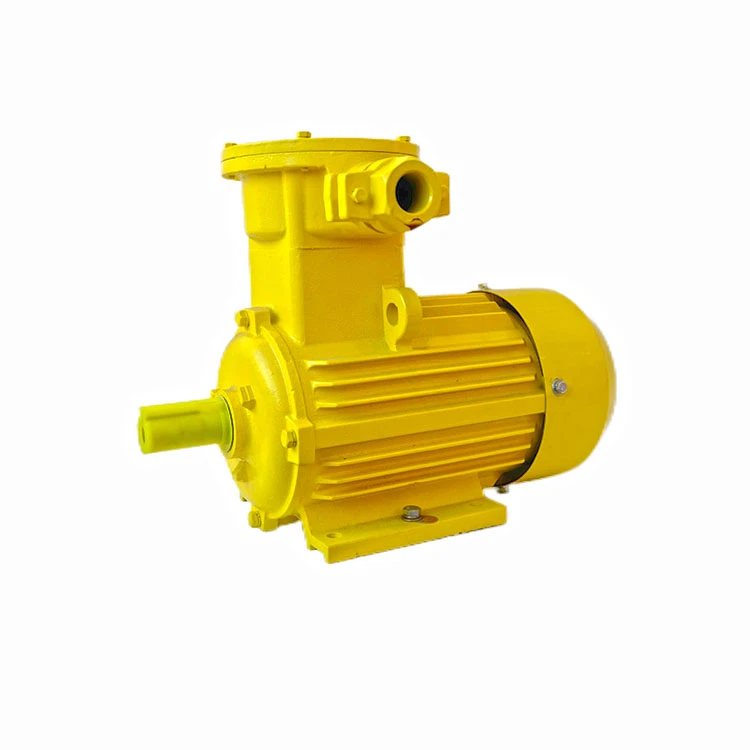
Now, let me introduce some of our High Efficiency IE3 Explosion - proof Motors. We have the YBX3-100L2-4 3kw Induction Motor IP55, which is a great choice for many industrial applications. It's highly efficient and has good explosion - proof performance. Our YBX3 Three Phase Explosion Proof Motor is also very popular. It's designed to meet the strict safety requirements of explosive environments. And if you need a more advanced option, our YBX4 Flameproof Three Phase Asynchronous Motor offers even better performance and reliability.
If you're in the market for High Efficiency IE3 Explosion - proof Motors and need help with speed control or have any other questions, don't hesitate to reach out. We're here to provide you with the best solutions for your industrial needs. Whether you're working in a small - scale chemical plant or a large - scale oil refinery, we have the right motor for you.

References
- Chapman, S. J. (2012). Electric Machinery Fundamentals. McGraw - Hill.
- Fitzgerald, A. E., Kingsley, C., Jr., & Umans, S. D. (2003). Electric Machinery. McGraw - Hill.


