

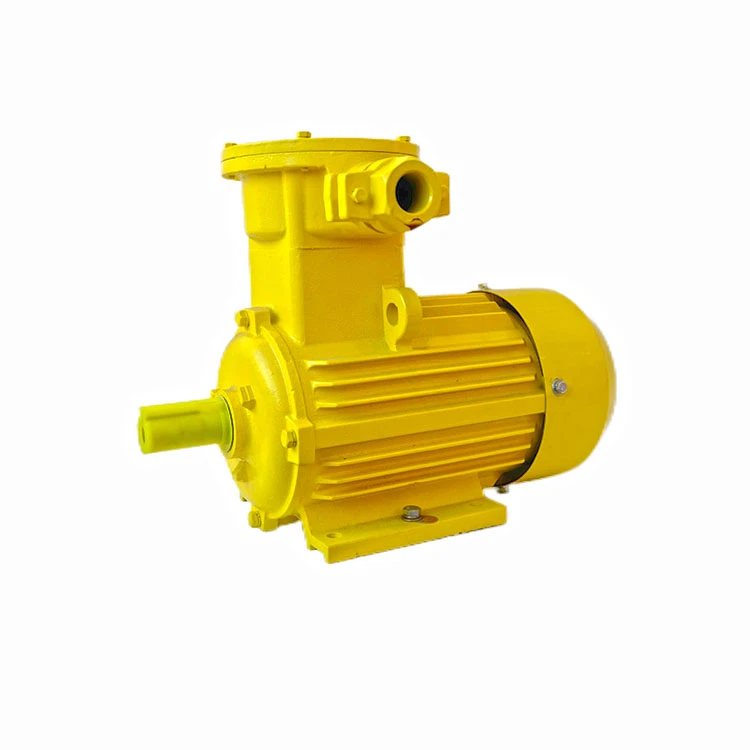
As a supplier of YB explosion-proof motors, I often encounter inquiries from customers about the various speed control methods available for these motors. Understanding the different speed control techniques is crucial for optimizing the performance of YB explosion-proof motors in diverse industrial applications, especially in hazardous environments where safety and efficiency are of utmost importance. In this blog post, I will delve into the most common speed control methods for YB explosion-proof motors and their respective advantages and limitations.
Variable Frequency Drives (VFDs)
Variable Frequency Drives, also known as adjustable frequency drives, are one of the most popular speed control methods for YB explosion-proof motors. VFDs work by varying the frequency and voltage supplied to the motor, which in turn changes the motor's speed. This method offers several advantages, including precise speed control, energy savings, and soft-start capabilities.
Precise speed control is a significant benefit of using VFDs. In many industrial processes, such as conveyor systems, pumps, and fans, maintaining a specific speed is essential for optimal performance. VFDs allow for accurate speed adjustment, ensuring that the motor operates at the desired speed, which can improve product quality and reduce wear and tear on the equipment.
Energy savings are another major advantage of VFDs. By adjusting the motor speed to match the load requirements, VFDs can significantly reduce energy consumption. For example, in a pumping system, if the demand for water is low, the VFD can reduce the motor speed, thereby reducing the energy used. This not only saves on electricity costs but also contributes to a more sustainable operation.
Soft-start capabilities are also provided by VFDs. When a motor starts, it typically draws a large amount of current, which can cause voltage dips in the electrical system and stress on the motor windings. VFDs can gradually ramp up the motor speed, reducing the inrush current and minimizing the impact on the electrical system and the motor.
However, VFDs also have some limitations. They can be relatively expensive to purchase and install, especially for smaller motors. Additionally, VFDs generate harmonic distortion, which can affect the quality of the electrical supply and cause interference with other equipment. Proper filtering and grounding are required to mitigate these issues.
Pole Changing
Pole changing is another speed control method used for YB explosion-proof motors. This method involves changing the number of poles in the motor's stator winding to alter the motor's synchronous speed. The synchronous speed of an AC motor is determined by the frequency of the power supply and the number of poles in the motor. By changing the number of poles, the motor can operate at different speeds.
Pole changing offers a simple and cost-effective way to achieve multiple speeds. It is commonly used in applications where a few discrete speed settings are required, such as in some types of machine tools and hoists. The motor can be designed with multiple sets of windings, allowing for easy switching between different pole configurations.
One of the advantages of pole changing is its reliability. Since it does not rely on complex electronic components like VFDs, there is less chance of electronic failure. This makes it a suitable option for applications where reliability is a primary concern.

However, pole changing has some limitations. It provides only a limited number of discrete speed settings, and the speed change is not continuous. This may not be suitable for applications that require precise and continuous speed control. Additionally, the motor design for pole changing can be more complex, and the efficiency may be lower compared to motors with a fixed number of poles.
Eddy Current Couplings
Eddy current couplings are a type of mechanical speed control device that can be used with YB explosion-proof motors. An eddy current coupling consists of a magnetic rotor and a conductive rotor. The magnetic rotor is connected to the motor shaft, and the conductive rotor is connected to the load. When the motor rotates, it creates a magnetic field that induces eddy currents in the conductive rotor, which in turn creates a torque that drives the load.
The speed of the load can be controlled by adjusting the magnetic field strength between the two rotors. This can be done by varying the current supplied to the magnetic coil in the coupling. Eddy current couplings offer smooth and stepless speed control, making them suitable for applications that require precise speed adjustment.
One of the advantages of eddy current couplings is their simplicity and reliability. They do not require complex electronic controls, and they can operate in harsh environments. They also provide overload protection, as the coupling will slip if the load exceeds a certain limit, preventing damage to the motor and the load.
However, eddy current couplings have some drawbacks. They are less efficient than direct drive systems, as some energy is lost in the form of heat due to the eddy currents. This can result in higher energy consumption and the need for additional cooling. Additionally, the size and weight of eddy current couplings can be relatively large, which may be a limitation in some applications.
Stator Voltage Control
Stator voltage control is a speed control method that involves varying the voltage supplied to the motor's stator winding. By reducing the stator voltage, the motor's speed can be decreased. This method is relatively simple and inexpensive, as it does not require complex electronic components.
Stator voltage control is commonly used in applications where a small reduction in speed is required, such as in some types of fans and blowers. It can also be used in conjunction with other speed control methods to provide additional speed adjustment.
One of the advantages of stator voltage control is its simplicity. It can be implemented using a simple variable transformer or a solid-state voltage controller. This makes it a cost-effective option for small-scale applications.
However, stator voltage control has some limitations. It is not suitable for applications that require a large reduction in speed, as reducing the voltage too much can cause the motor to overheat and lose torque. Additionally, the speed regulation is not as precise as with other methods, such as VFDs.
Conclusion
In conclusion, there are several speed control methods available for YB explosion-proof motors, each with its own advantages and limitations. Variable Frequency Drives offer precise speed control and energy savings but can be expensive and generate harmonic distortion. Pole changing provides a simple and cost-effective way to achieve multiple discrete speeds but has limited speed options. Eddy current couplings offer smooth and stepless speed control but are less efficient. Stator voltage control is simple and inexpensive but has limited speed reduction capabilities.
When selecting a speed control method for a YB explosion-proof motor, it is important to consider the specific requirements of the application, such as the required speed range, precision, energy efficiency, and cost. As a supplier of YB explosion-proof motors, we offer a wide range of products, including the YBX3-100L2-4 3kw Induction Motor IP55, YBX3 Three Phase Explosion Proof Motor, and High Efficiency IE3 Explosion-proof Motor. Our team of experts can help you choose the most suitable speed control method for your application.
If you are interested in learning more about our YB explosion-proof motors and the available speed control methods, or if you have any specific requirements for your project, please do not hesitate to contact us. We are ready to assist you in finding the best solution for your needs.
References
- Electric Machinery Fundamentals, Stephen J. Chapman
- Industrial Electric Motor Handbook, Paul C. Krause


