

Hey there! As a supplier of High Efficiency IE3 Explosion - proof Motors, I often get asked about the temperature rise limit of these motors. In this blog, I'll dive deep into this topic and share some insights that I've gathered over the years in the industry.
First off, let's understand why the temperature rise limit is such a big deal. High - temperature operation can have a huge impact on the performance and lifespan of an explosion - proof motor. When a motor runs at excessive temperatures, it can cause the insulation materials to degrade faster. This insulation is crucial as it helps prevent electrical short - circuits and keeps the motor running safely. If the insulation breaks down prematurely, it can lead to motor failures, which are not only costly to repair but can also pose a significant safety risk, especially in explosive environments.
So, what exactly is the temperature rise limit for High Efficiency IE3 Explosion - proof Motors? Well, it's not a one - size - fits - all answer. The temperature rise limit is determined by several factors, including the motor's insulation class, the ambient temperature, and the duty cycle.
Insulation class plays a major role here. Motors are typically classified into different insulation classes such as Class A, Class E, Class B, Class F, and Class H. Each class has a specific maximum allowable temperature rise. For example, Class A insulation has a relatively lower temperature rise limit compared to Class H. Class A can usually tolerate a temperature rise of around 60°C, while Class H can handle up to 125°C. High Efficiency IE3 Explosion - proof Motors often use Class F or Class H insulation because of their high - efficiency requirements and the need to operate in potentially harsh conditions. With Class F insulation, the motor can have a temperature rise of up to 105°C, which gives it a good balance between performance and durability.
The ambient temperature also affects the temperature rise limit. The ambient temperature is the temperature of the surrounding environment where the motor is installed. If the motor is operating in a hot environment, say in a factory with high - temperature processes or in a tropical climate, the motor has less room for temperature rise. For instance, if the ambient temperature is 40°C and the motor has a Class F insulation with a 105°C temperature rise limit, the maximum operating temperature of the motor will be 145°C (40°C + 105°C). So, when selecting a motor, it's important to consider the ambient temperature and choose a motor with an appropriate insulation class.
The duty cycle is another factor. The duty cycle refers to how often and for how long the motor runs. There are different types of duty cycles, such as continuous duty (S1), short - time duty (S2), and intermittent periodic duty (S3). In continuous duty, the motor runs non - stop, which means it has to dissipate heat continuously. In this case, the temperature rise limit needs to be carefully considered to ensure the motor doesn't overheat. On the other hand, in short - time duty, the motor runs for a short period and then has a rest period. This allows the motor to cool down, so the temperature rise might not be as critical as in continuous duty.
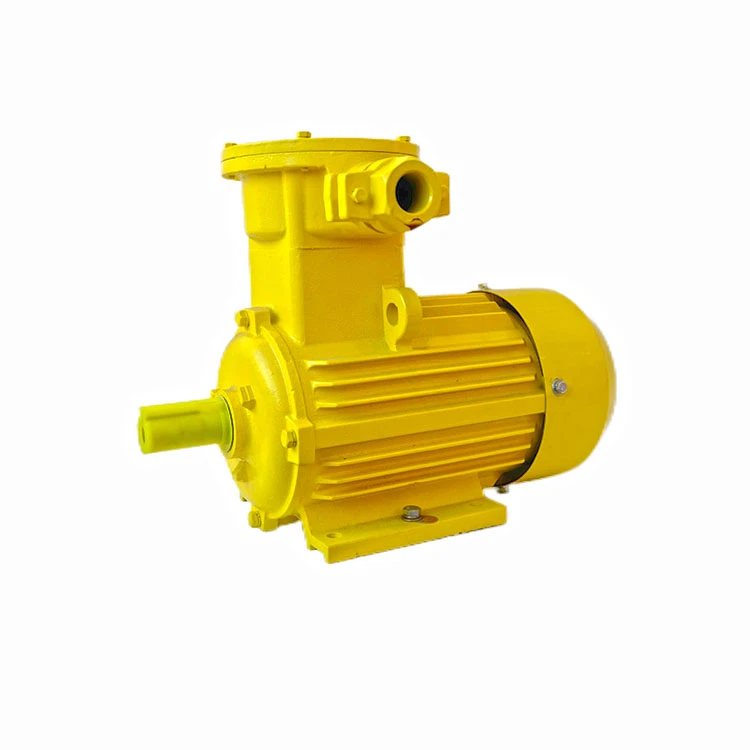
Now, let's talk about our products. We offer a wide range of High Efficiency IE3 Explosion - proof Motors, like the YBX3 - 100L2 - 4 3kw Induction Motor IP55 and the YBX4 Flameproof Three Phase Asynchronous Motor. These motors are designed to meet strict temperature rise limits. They are built with high - quality insulation materials, usually Class F or Class H, to ensure they can operate safely even in high - temperature environments. Our High Efficiency IE3 Explosion - proof Motor series is engineered to provide maximum efficiency while keeping the temperature rise within the acceptable limits.
We also take other measures to control the temperature rise. For example, we use advanced cooling systems. Some of our motors are equipped with external fans or heat sinks to help dissipate heat more effectively. These cooling systems work in tandem with the motor's design to ensure that the temperature stays within the safe range.
In addition, we conduct rigorous testing on our motors. Before they leave the factory, each motor undergoes a series of tests, including temperature rise tests. We simulate different operating conditions, such as high - ambient temperatures and different duty cycles, to make sure the motor can handle real - world scenarios. This way, we can guarantee that our motors meet or exceed the industry standards for temperature rise limits.
If you're in the market for High Efficiency IE3 Explosion - proof Motors, it's important to understand the temperature rise limit and its implications. You need to consider the specific requirements of your application, such as the ambient temperature, the duty cycle, and the level of safety needed. And if you have any questions or need more information, don't hesitate to reach out to us. We're here to help you choose the right motor for your needs. Whether you're in the mining industry, the chemical industry, or any other industry that requires explosion - proof motors, we have the expertise and the products to meet your demands.
In conclusion, the temperature rise limit of High Efficiency IE3 Explosion - proof Motors is a complex but important aspect to consider. By understanding the factors that affect the temperature rise limit, such as insulation class, ambient temperature, and duty cycle, you can make an informed decision when purchasing a motor. And when you choose our products, you can be confident that you're getting a high - quality motor that is designed to operate safely and efficiently within the appropriate temperature rise limits.

If you're interested in our High Efficiency IE3 Explosion - proof Motors, or if you want to discuss your specific requirements, feel free to contact us for a purchase negotiation. We're looking forward to working with you!
References:
- Electrical Machinery Fundamentals by Stephen Chapman
- IEEE Standards for Rotating Electrical Machines


