

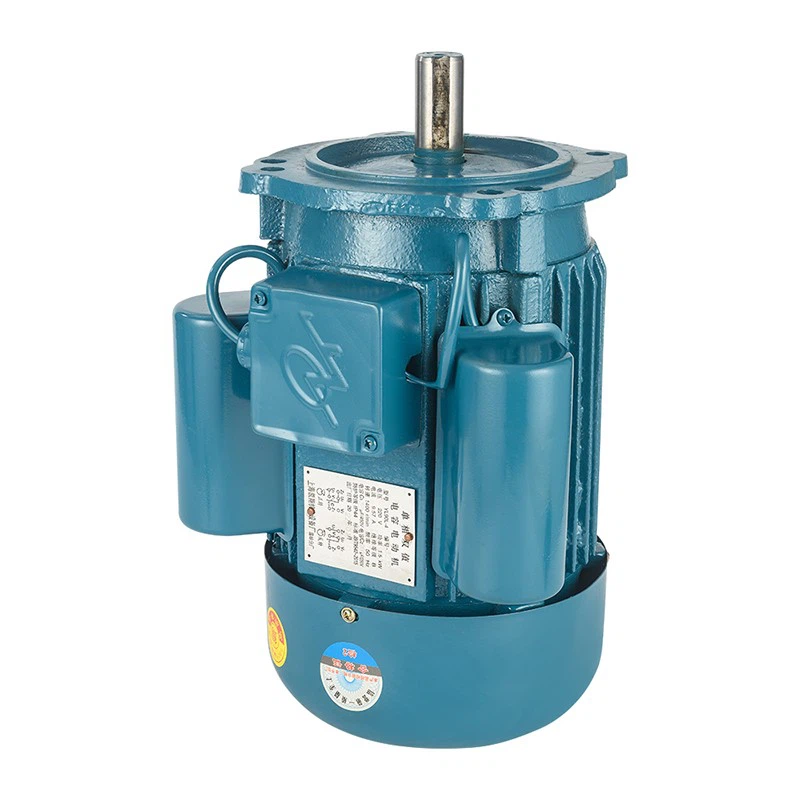
Hey there! I'm a supplier of YY 220V 0.75KW 1.5KW Single Phase Motors. You know, over - current is a real headache when it comes to these motors. It can not only damage the motor but also cause safety hazards. So, in this blog, I'm gonna share some tips on how to protect these motors from over - current.
Understanding Over - Current in Single Phase Motors
First off, let's understand what over - current is. Simply put, over - current happens when the current flowing through the motor exceeds its rated value. There are a few reasons for this. One common cause is a mechanical overload. For example, if the motor is driving a load that's too heavy, it has to work harder, and that leads to an increase in current. Another reason could be a short - circuit in the motor windings. When there's a short - circuit, the resistance in the circuit drops, and according to Ohm's law (V = IR, where V is voltage, I is current, and R is resistance), with a constant voltage (220V in our case), a decrease in resistance will result in an increase in current.
Choosing the Right Protection Devices
Fuses
Fuses are one of the simplest and most common over - current protection devices. They work by melting when the current exceeds a certain value, thus breaking the circuit. When selecting a fuse for your YY 220V 0.75KW 1.5KW Single Phase Motor, you need to choose one with the right rating. The rating should be slightly higher than the normal operating current of the motor. For a 0.75KW motor, the normal operating current can be calculated using the formula (P = VI\cos\varphi) (where (P) is power, (V) is voltage, (I) is current, and (\cos\varphi) is the power factor. For a single - phase motor, (\cos\varphi) is usually around 0.8). So, (I=\frac{P}{V\cos\varphi}). For a 0.75KW (750W) motor, (I=\frac{750}{220\times0.8}\approx4.3A). You might choose a fuse with a rating of around 5A.
Circuit Breakers
Circuit breakers are another great option. Unlike fuses, which need to be replaced after they blow, circuit breakers can be reset. They come in different types, such as thermal - magnetic circuit breakers. Thermal circuit breakers work based on the heating effect of the current. When the current is too high, the heat causes a bimetallic strip to bend and trip the breaker. Magnetic circuit breakers, on the other hand, use a solenoid to detect high - current surges. When the current exceeds a certain value, the magnetic field generated by the solenoid is strong enough to trip the breaker.
Monitoring and Control
Current Sensors
Installing current sensors can help you monitor the current flowing through the motor in real - time. These sensors can be connected to a control system, which can then take action if the current exceeds a set limit. For example, if the current sensor detects that the current is getting too high, the control system can send a signal to shut down the motor or reduce the load.

Motor Protection Relays
Motor protection relays are more advanced devices that can provide multiple types of protection, including over - current protection. They can monitor various parameters of the motor, such as current, voltage, and temperature. If any of these parameters go out of the normal range, the relay can trip and disconnect the motor from the power supply.
Proper Installation and Maintenance
Correct Wiring
Proper wiring is crucial to prevent over - current situations. Make sure all the connections are tight and secure. Loose connections can cause resistance to increase at the connection points, which can lead to over - heating and over - current. Also, use the right gauge of wire. A wire that's too thin can have a high resistance, which can cause the current to increase.
Regular Maintenance
Regular maintenance of the motor is essential. Check the motor windings for signs of damage or short - circuits. Clean the motor regularly to prevent dust and debris from accumulating, which can affect the motor's performance and lead to over - heating. Lubricate the bearings as needed to reduce friction, which can also help prevent over - current situations.
Other Considerations
Load Management
Proper load management is key to protecting the motor from over - current. Make sure the motor is not being overloaded. If you need to increase the load, consider upgrading to a more powerful motor. Also, avoid sudden starts and stops, as these can cause high - current surges.
Environmental Factors
The environment in which the motor operates can also affect its performance and the risk of over - current. High temperatures can reduce the motor's efficiency and increase the likelihood of over - heating. Make sure the motor is installed in a well - ventilated area. Humidity can also cause corrosion of the motor components, which can lead to short - circuits and over - current.
In conclusion, protecting your YY 220V 0.75KW 1.5KW Single Phase Motor from over - current requires a combination of choosing the right protection devices, monitoring and control, proper installation and maintenance, and good load management. If you're looking for high - quality single - phase motors, we also have some Hot Selling YL Single Phase Asynchronous Motor and Hot Selling YL Single Phase Asynchronous Motor as well as YCL Heavy Duty Two Capacitors Single Phase Motor available.
If you're interested in purchasing our motors or have any questions about motor protection, feel free to get in touch with us for further discussion and negotiation. We're always here to help you find the best solutions for your motor needs.
References
- Electrical Engineering Handbook, CRC Press
- Motor and Drive Systems Handbook, McGraw - Hill


