

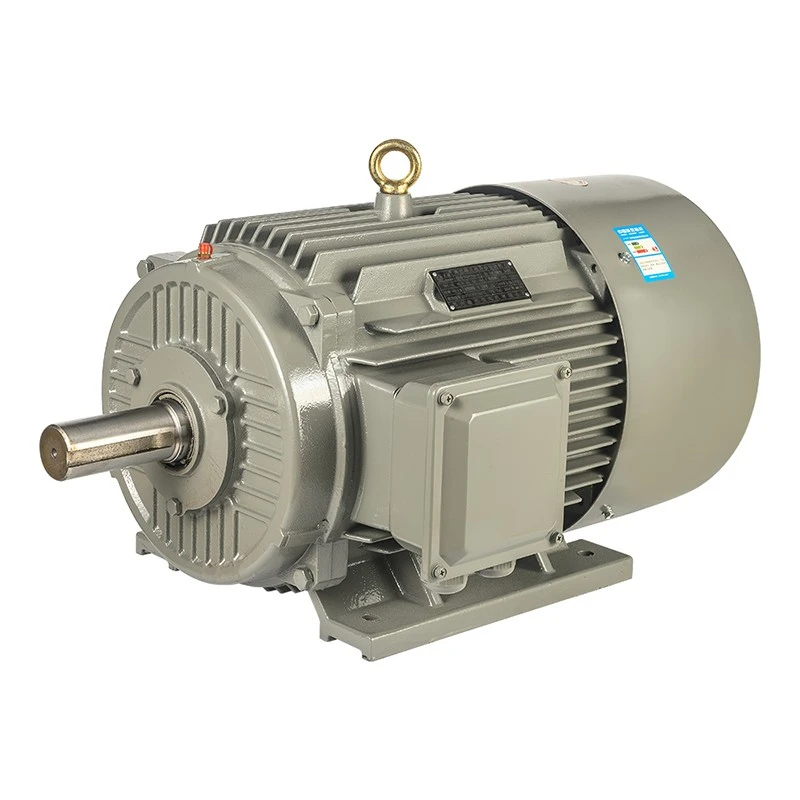
When it comes to the operation of a Three - phase AC Motor with 7.5 Hp, 1440 Rpm, and 5.5 Kw, one of the critical aspects that both suppliers and users need to understand is the temperature rise during operation. As a supplier of this type of motor, I've encountered numerous inquiries regarding this topic. In this blog, I'll delve into the factors influencing the temperature rise of such motors, the acceptable temperature ranges, and how to manage and monitor this crucial parameter.
Factors Affecting Temperature Rise
Electrical Losses
The first and most significant factor contributing to the temperature rise of a three - phase AC motor is electrical losses. These losses occur mainly in the stator windings and the rotor. In the stator, when an alternating current passes through the copper windings, resistive heating takes place according to Joule's law ((P = I^{2}R)), where (P) is the power loss, (I) is the current, and (R) is the resistance of the winding. The higher the current and the resistance, the more heat is generated.
In the rotor, similar resistive losses occur. Additionally, there are also losses due to induction. When the rotating magnetic field of the stator induces currents in the rotor, these currents flow through the rotor conductors, causing heat to be dissipated. The magnitude of these losses depends on the load on the motor. A higher load generally means a higher current in both the stator and the rotor, leading to increased electrical losses and thus a higher temperature rise.
Core Losses
Core losses are another important factor. These losses occur in the iron core of the motor, which is made up of laminated steel sheets. There are two main types of core losses: hysteresis losses and eddy - current losses.
Hysteresis losses are caused by the repeated magnetization and demagnetization of the iron core as the alternating magnetic field changes. Each time the magnetic field reverses, energy is lost in the form of heat. Eddy - current losses, on the other hand, are due to the induced currents (eddy currents) in the iron core. These currents flow in circular paths within the core and are dissipated as heat. To reduce eddy - current losses, the core is laminated, which increases the resistance of the paths for the eddy currents.
Mechanical Losses
Mechanical losses also play a role in the temperature rise of the motor. These losses include friction losses in the bearings and windage losses due to the rotation of the motor's rotor in the air. Friction in the bearings can generate heat, especially if the bearings are not properly lubricated or if there is misalignment. Windage losses occur as the rotor moves through the air, and the energy required to overcome the air resistance is dissipated as heat.
Environmental Factors
The environment in which the motor operates can significantly affect its temperature rise. High ambient temperatures can reduce the motor's ability to dissipate heat. If the motor is installed in a confined space with poor ventilation, the heat generated during operation cannot be effectively removed, leading to a higher temperature rise. Additionally, factors such as humidity and dust can also impact the motor's performance and temperature. For example, dust accumulation on the motor's surface can act as an insulator, reducing heat transfer.
Acceptable Temperature Ranges
The acceptable temperature rise of a three - phase AC motor is determined by several standards and the motor's insulation class. Different insulation classes have different temperature limits. For example, Class A insulation has a maximum allowable temperature rise of 60°C above the ambient temperature, while Class B insulation allows a temperature rise of 80°C, and Class F insulation can tolerate a temperature rise of 105°C.
The ambient temperature is typically considered to be 40°C. So, for a motor with Class B insulation, the maximum operating temperature would be (40 + 80=120^{\circ}C). It's important to note that exceeding these temperature limits can significantly reduce the motor's lifespan. High temperatures can cause the insulation to degrade more rapidly, leading to short - circuits and motor failure.

Monitoring and Managing Temperature Rise
As a supplier, I always recommend our customers to monitor the temperature rise of the motor during operation. There are several ways to do this. One common method is to use temperature sensors, such as thermocouples or resistance temperature detectors (RTDs), which can be installed in the motor windings or on the motor surface. These sensors can provide real - time temperature data, allowing operators to detect any abnormal temperature rises early.
Another important aspect is proper ventilation. Ensuring that the motor has adequate ventilation can help to dissipate heat effectively. This can be achieved by installing fans or using natural convection. Regular maintenance is also crucial. This includes checking the lubrication of the bearings, cleaning the motor to remove dust and debris, and inspecting the windings for any signs of damage.
Comparison with Other Motors
When comparing our 7.5 Hp, 1440 Rpm, 5.5 Kw three - phase AC motor with other types of motors, it's interesting to note the differences in temperature rise. For example, a Three Phase Engine Shaded Pole Asynchronous Motor may have a different temperature - rise characteristic due to its different design and operating principles. Shaded - pole motors are generally less efficient than three - phase induction motors, which means they may have a higher temperature rise for the same power output.
A Low Rpm Electric Motor Three Phase Electric Motor may also have unique temperature - rise characteristics. Low - RPM motors often have different winding configurations and load - torque characteristics, which can affect the electrical and mechanical losses and thus the temperature rise.
The YE2 - 80M2 - 4 1HP Three Phase Electric Motor is a smaller - power motor compared to our 7.5 Hp motor. Smaller motors generally have a higher surface - area - to - volume ratio, which means they can dissipate heat more easily. However, they may also have different insulation classes and operating requirements, which need to be considered when comparing temperature rises.
Conclusion
In conclusion, understanding the temperature rise of a three - phase AC motor with 7.5 Hp, 1440 Rpm, and 5.5 Kw is essential for both suppliers and users. By considering the factors influencing temperature rise, such as electrical losses, core losses, mechanical losses, and environmental factors, and by monitoring and managing the temperature within the acceptable ranges, the motor's performance and lifespan can be optimized.
If you are in the market for a high - quality three - phase AC motor with these specifications, or if you have any questions regarding temperature rise or other aspects of motor operation, we are here to assist you. We can provide detailed technical information and offer customized solutions to meet your specific needs. Feel free to reach out to us for more information and to start a procurement discussion.
References
- Fitzgerald, A. E., Kingsley, C., & Umans, S. D. (2003). Electric Machinery. McGraw - Hill.
- Chapman, S. J. (2012). Electric Machinery Fundamentals. McGraw - Hill.


