

As a supplier of Squirrel Cage Three Phase Asynchronous Motors, I've encountered numerous inquiries about the starting current of these motors. This topic is crucial for both engineers and end - users, as it impacts the motor's performance, the electrical system's design, and overall energy efficiency. In this blog, I'll delve into the concept of starting current, its influencing factors, and its implications in practical applications.
Understanding the Starting Current
The starting current of a Squirrel Cage Three Phase Asynchronous Motor refers to the current drawn by the motor when it is initially energized and starts to rotate from a stand - still position. Unlike the normal operating current, which is relatively stable during the motor's regular operation, the starting current is significantly higher.
When the motor starts, the rotor is stationary, and the relative speed between the rotating magnetic field of the stator and the rotor is at its maximum. According to Faraday's law of electromagnetic induction, the induced electromotive force (EMF) in the rotor is proportional to the relative speed. A large induced EMF in the rotor leads to a large current flowing in the rotor circuit. Due to the magnetic coupling between the stator and the rotor, the stator also draws a large current from the power supply to maintain the magnetic field.
Typically, the starting current of a Squirrel Cage Three Phase Asynchronous Motor can be 5 - 8 times the rated current. For example, if a motor has a rated current of 10 amperes, its starting current can reach 50 - 80 amperes. This high - magnitude current is transient, lasting only a few seconds until the motor reaches its normal operating speed.
Factors Influencing the Starting Current
Several factors can affect the starting current of a Squirrel Cage Three Phase Asynchronous Motor:
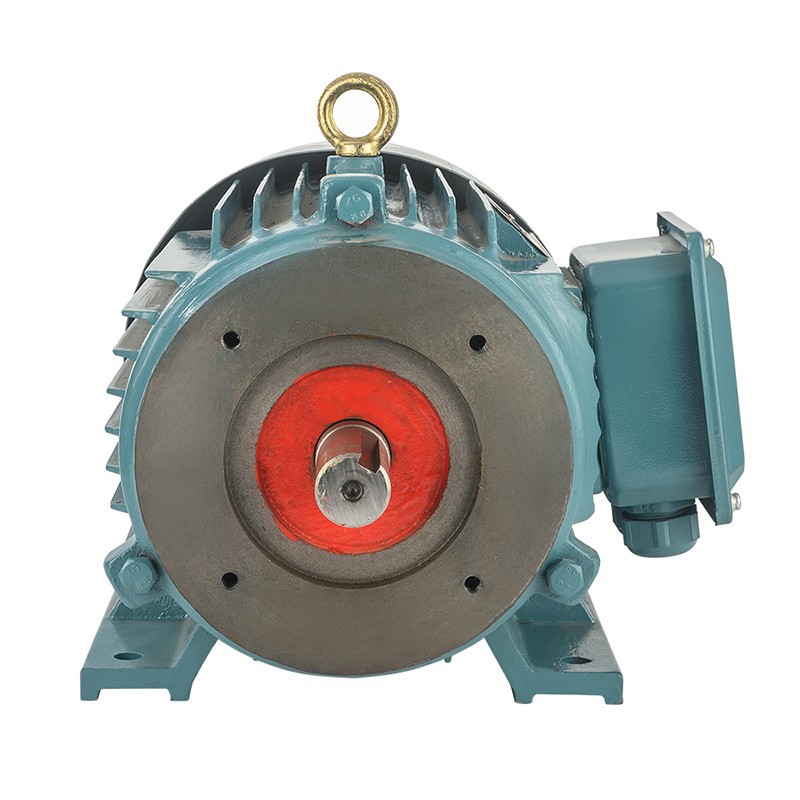

Motor Design
The design of the motor, including the number of stator windings, the cross - sectional area of the conductors, and the rotor resistance, plays a significant role. Motors with lower rotor resistance generally have higher starting currents because a lower resistance allows for a larger current to flow in the rotor circuit when the induced EMF is large.
Supply Voltage
The supply voltage has a direct impact on the starting current. A higher supply voltage will result in a larger induced EMF in the rotor and, consequently, a higher starting current. Conversely, a lower supply voltage will reduce the starting current, but it may also affect the motor's ability to start and accelerate to its normal speed.
Load Inertia
The inertia of the load connected to the motor affects the starting time and the starting current. A load with high inertia, such as a large flywheel or a heavy conveyor belt, requires more torque to start rotating. To provide this additional torque, the motor needs to draw more current during the starting process. As a result, the starting current will be higher, and the starting time will be longer.
Implications of High Starting Current
The high starting current of Squirrel Cage Three Phase Asynchronous Motors has several implications:
Electrical System Stress
The large starting current can cause a significant voltage drop in the electrical system, especially in systems with long cables or weak power supplies. This voltage drop can affect other electrical equipment connected to the same system, leading to malfunctions or reduced performance.
Motor Heating
The high starting current generates a large amount of heat in the motor windings. If the motor starts frequently, the accumulated heat can cause the motor temperature to rise, potentially damaging the insulation of the windings and reducing the motor's lifespan.
Energy Consumption
Although the starting process is transient, the high starting current still consumes a considerable amount of energy. In applications where the motor starts and stops frequently, this additional energy consumption can be a significant cost factor.
Mitigating the Starting Current
To reduce the negative impacts of high starting current, several methods can be employed:
Star - Delta Starter
A star - delta starter is a common method for reducing the starting current. In the starting phase, the motor windings are connected in a star configuration, which reduces the voltage applied to each winding and, consequently, the starting current. Once the motor reaches a certain speed, the windings are re - connected in a delta configuration for normal operation.
Soft Starter
A soft starter gradually increases the voltage applied to the motor during the starting process, allowing the motor to start smoothly with a reduced starting current. Soft starters can be adjusted to control the starting time and the rate of voltage increase, providing more flexibility in different applications.
Variable Frequency Drive (VFD)
A VFD can control the frequency and voltage of the power supply to the motor. By starting the motor at a low frequency and gradually increasing it, the VFD can limit the starting current and provide precise control over the motor's speed and torque.
Our Product Offerings
As a supplier of Squirrel Cage Three Phase Asynchronous Motors, we offer a wide range of products to meet different customer needs. Our Water Pump Electric Motor Winding Motor is designed for water - pumping applications, providing reliable performance and high efficiency. The IE4 Ultra High Efficiency Asynchronous Motor features ultra - high efficiency, reducing energy consumption and operating costs. Our Horizontal Foot Mounting YE3 Asynchronous Motor is suitable for various industrial applications with its robust design and easy installation.
Contact Us for Procurement
If you are interested in our Squirrel Cage Three Phase Asynchronous Motors or have any questions about starting current or motor selection, please feel free to contact us. Our team of experts is ready to provide you with professional advice and support. Whether you need a motor for a small - scale project or a large - scale industrial application, we can offer you the right solution.
References
- Chapman, S. J. (2012). Electric Machinery Fundamentals. McGraw - Hill.
- Fitzgerald, A. E., Kingsley, C., & Umans, S. D. (2003). Electric Machinery. McGraw - Hill.


