

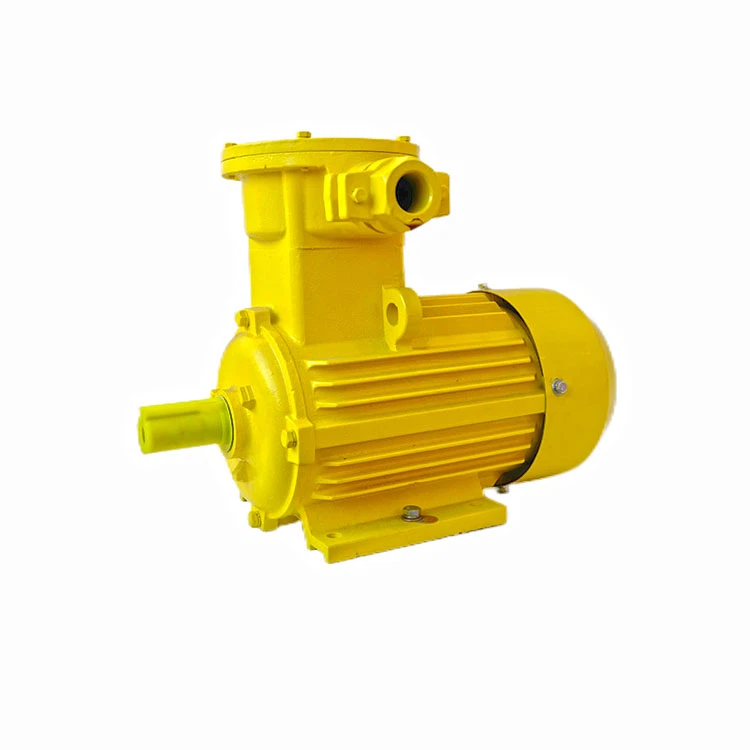
As a dedicated supplier of YBX3 Three Phase Explosion Proof Motors, I've witnessed firsthand the critical role these motors play in various industrial applications, especially in environments where safety and efficiency are non - negotiable. One key technical parameter that often comes up in discussions is the power factor. In this blog post, I'll delve into what the power factor of YBX3 Three Phase Explosion Proof Motor is, its importance, and how it impacts the performance of these motors.
Understanding Power Factor
Before discussing the power factor of YBX3 motors specifically, let's first understand what power factor means. Power factor (PF) is a measure of how effectively electrical power is being used by a device. It is the ratio of real power (P), which is the power that actually does work, to apparent power (S). Mathematically, it can be expressed as:
[PF=\frac{P}{S}]
Apparent power (S) is the product of the voltage (V) and current (I) in an AC circuit ((S = VI)), while real power (P) is the power that is dissipated or used in the load. The difference between apparent power and real power is due to reactive power (Q), which is associated with the energy stored and released in inductive or capacitive elements in the circuit.
A power factor of 1 (or 100%) indicates that all the electrical power supplied to the device is being used effectively to do work. A lower power factor means that a significant portion of the electrical power is being used to maintain the electromagnetic fields in inductive or capacitive elements rather than performing useful work. This results in increased current flow for the same amount of real power, leading to higher energy losses in the power distribution system.
Power Factor of YBX3 Three Phase Explosion Proof Motor
YBX3 Three Phase Explosion Proof Motors are designed to operate in hazardous environments where there is a risk of explosion due to the presence of flammable gases, vapors, or dust. These motors are typically induction motors, which are known for having a power factor that varies depending on the load.
Under normal operating conditions, the power factor of YBX3 motors usually ranges from 0.7 to 0.9. At full load, the power factor tends to be closer to 0.9, which is relatively high. This means that the motor is using a large proportion of the supplied electrical power to do useful work, such as driving pumps, fans, or conveyors.
However, when the motor is operating at a partial load, the power factor decreases. For example, at 25% of the full load, the power factor may drop to around 0.7. This is because the reactive power component remains relatively constant regardless of the load, while the real power decreases as the load decreases. As a result, the ratio of real power to apparent power (the power factor) also decreases.
Importance of Power Factor in YBX3 Motors
The power factor of YBX3 Three Phase Explosion Proof Motors is of great importance for several reasons:

Energy Efficiency
A higher power factor means that the motor is using electrical power more efficiently. This translates into lower energy consumption, which can result in significant cost savings over the motor's operating life. In industries where motors are running continuously, such as in chemical plants or mining operations, even a small improvement in power factor can lead to substantial energy savings.
Reduced Electrical Network Losses
As mentioned earlier, a lower power factor requires a higher current flow for the same amount of real power. This increased current leads to higher energy losses in the electrical cables, transformers, and other components of the power distribution system. By using motors with a higher power factor, these losses can be reduced, improving the overall efficiency of the electrical network.
Compliance with Electrical Standards
Many countries and regions have electrical standards and regulations that require industrial users to maintain a certain minimum power factor. By using YBX3 motors with a relatively high power factor, industrial plants can ensure compliance with these standards, avoiding potential fines or penalties.
Improving the Power Factor of YBX3 Motors
There are several ways to improve the power factor of YBX3 Three Phase Explosion Proof Motors:
Proper Sizing of the Motor
Selecting the right size of the motor for the specific application is crucial. An oversized motor will operate at a lower load most of the time, resulting in a lower power factor. On the other hand, an undersized motor may not be able to handle the load, leading to overheating and reduced efficiency. By accurately sizing the motor based on the load requirements, the power factor can be optimized.
Power Factor Correction Capacitors
Power factor correction capacitors can be installed in parallel with the motor to reduce the reactive power draw. These capacitors supply the reactive power locally, reducing the amount of reactive power that needs to be drawn from the power grid. As a result, the power factor of the motor and the overall electrical system is improved.
Our Product Offerings
We are proud to offer a wide range of YBX3 Three Phase Explosion Proof Motors, including the YBX3 - 100L2 - 4 3kw Induction Motor IP55 and the High Efficiency IE3 Explosion - proof Motor. These motors are designed with the latest technology to ensure high power factor, energy efficiency, and reliable performance in hazardous environments. You can explore our full product line of YBX3 Three Phase Explosion Proof Motor on our website.
Conclusion
The power factor of YBX3 Three Phase Explosion Proof Motors is a crucial parameter that affects their energy efficiency, electrical network losses, and compliance with standards. By understanding the concept of power factor and taking appropriate measures to improve it, industrial users can optimize the performance of these motors and achieve significant cost savings.
If you are interested in our YBX3 Three Phase Explosion Proof Motors or want to discuss your specific requirements, please feel free to contact us for a detailed consultation and procurement negotiation. We are committed to providing you with the best solutions tailored to your needs.
References
- Chapman, S. J. (2012). Electric Machinery Fundamentals. McGraw - Hill Education.
- Fitzgerald, A. E., Kingsley Jr, C., & Umans, S. D. (2003). Electric Machinery. McGraw - Hill Education.


