

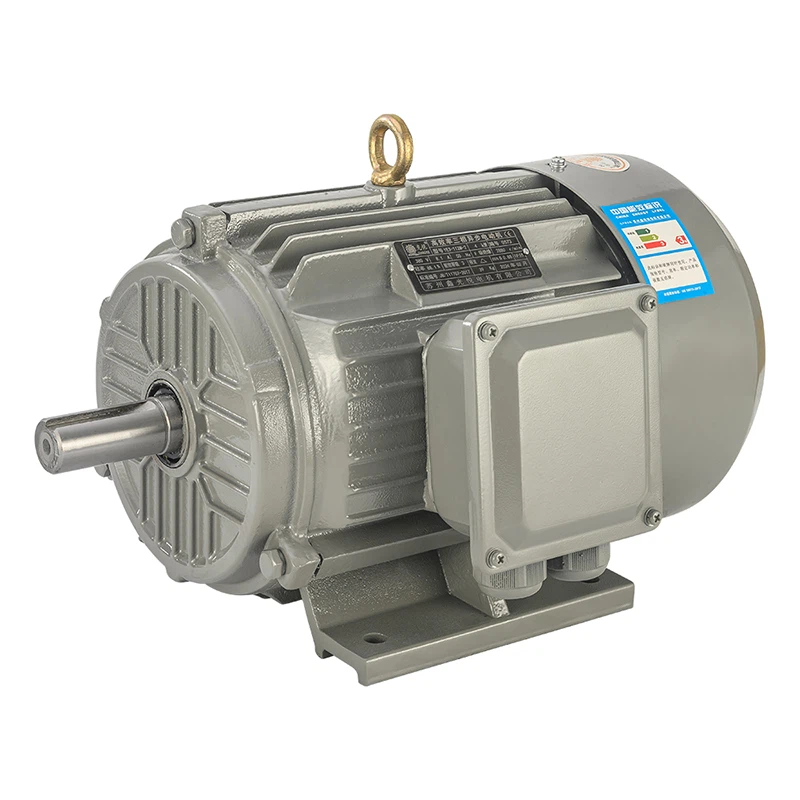
As a supplier of the Three - phase Ac Motor 7.5 Hp 1440 Rpm 5.5 Kw, I understand the importance of measuring the efficiency of this type of motor. In this blog, I will share some scientific and reasonable methods to measure the efficiency of our Three - phase Ac Motor, which can help you better understand the performance of the motor and make more informed decisions when purchasing.
Why Measuring Motor Efficiency Matters
Motor efficiency is a crucial parameter that reflects how effectively a motor converts electrical energy into mechanical energy. A high - efficiency motor not only reduces energy consumption but also cuts down on operating costs in the long run. For industrial users, improving motor efficiency can lead to significant savings in electricity bills and contribute to environmental protection by reducing carbon emissions. As a supplier, we are committed to providing high - efficiency motors, and accurate measurement of motor efficiency is the key to ensuring product quality.

Theoretical Basis of Motor Efficiency
The efficiency (η) of a motor is defined as the ratio of the mechanical power output (P_out) to the electrical power input (P_in), expressed by the formula:
[ \eta=\frac{P_{out}}{P_{in}}\times100% ]
The mechanical power output can be calculated by measuring the torque (T) and the rotational speed (ω) of the motor shaft using the formula (P_{out} = T\times\omega). The electrical power input is usually measured by monitoring the voltage (V), current (I), and power factor (PF) of the motor, with the formula (P_{in}=\sqrt{3}\times V\times I\times PF).
Measuring the Electrical Power Input
To measure the electrical power input of the Three - phase Ac Motor 7.5 Hp 1440 Rpm 5.5 Kw, we need to use appropriate measuring instruments. A power analyzer is a commonly used device for this purpose. It can accurately measure the voltage, current, and power factor of the three - phase power supply simultaneously.
First, connect the power analyzer to the motor's power supply circuit according to the manufacturer's instructions. Make sure the connections are secure and the measuring range of the instrument is appropriate for the motor's rated voltage and current. Once the power analyzer is properly connected, start the motor and let it run under stable conditions. The power analyzer will display the real - time values of voltage, current, and power factor. Then, calculate the electrical power input using the formula (P_{in}=\sqrt{3}\times V\times I\times PF).
Measuring the Mechanical Power Output
Measuring the mechanical power output is a bit more complex. One common method is to use a dynamometer. A dynamometer is a device that can measure the torque and rotational speed of the motor shaft.
There are different types of dynamometers, such as mechanical, hydraulic, and electric dynamometers. For our Three - phase Ac Motor, an electric dynamometer is often a good choice because of its high accuracy and wide measuring range.
Install the dynamometer on the motor shaft and couple them firmly. Start the motor and gradually increase the load on the dynamometer until the motor reaches its rated operating point. The dynamometer will measure the torque and rotational speed of the motor shaft. Convert the rotational speed from revolutions per minute (RPM) to radians per second (rad/s) using the conversion formula (\omega=\frac{2\pi\times n}{60}), where (n) is the rotational speed in RPM. Then, calculate the mechanical power output using the formula (P_{out}=T\times\omega).
Calculating the Motor Efficiency
After obtaining the values of the electrical power input ((P_{in})) and the mechanical power output ((P_{out})), we can calculate the efficiency of the motor using the formula (\eta=\frac{P_{out}}{P_{in}}\times100%).
For example, if the measured electrical power input is (P_{in} = 6000) watts and the measured mechanical power output is (P_{out}=5500) watts, then the efficiency of the motor is (\eta=\frac{5500}{6000}\times100%\approx91.67%).
Factors Affecting Motor Efficiency Measurement
There are several factors that can affect the accuracy of motor efficiency measurement.
Load Conditions: The efficiency of a motor varies with the load. A motor usually operates at its highest efficiency near its rated load. Therefore, when measuring the efficiency, it is important to ensure that the motor is operating under the rated load or a known load condition.
Temperature: The resistance of the motor's windings changes with temperature. As the motor runs, the temperature of the windings increases, which can affect the electrical power input and output. To obtain accurate measurement results, it is necessary to measure the temperature of the motor windings and make appropriate corrections.
Power Quality: The quality of the power supply, such as voltage imbalance and harmonic distortion, can also affect motor efficiency. Voltage imbalance can cause uneven current distribution in the motor windings, leading to increased losses. Harmonic distortion can increase the apparent power and reduce the power factor, resulting in inaccurate measurement of the electrical power input.
Our Product Line and Efficiency
As a supplier, we offer a wide range of three - phase AC motors, including the YE2 - 80M2 - 4 1HP Three Phase Electric Motor and the High Efficiency Copper Winding Washing Machine Motor. Our Three - phase Ac Motor 7.5 Hp 1440 Rpm 5.5 Kw is designed with high - quality materials and advanced manufacturing processes to ensure high efficiency and reliable performance.
We conduct strict efficiency testing on all our motors before they leave the factory. By using the measurement methods mentioned above, we can accurately measure the efficiency of each motor and ensure that it meets or exceeds the industry standards.
Contact for Purchase and Negotiation
If you are interested in our Three - phase Ac Motor 7.5 Hp 1440 Rpm 5.5 Kw or other products in our catalog, please feel free to contact us. We are more than willing to provide you with detailed product information, technical support, and competitive pricing. Whether you are an industrial user looking for high - efficiency motors or a distributor seeking reliable suppliers, we can offer you the best solutions.
References
- Fitzgerald, A. E., Kingsley, C., & Umans, S. D. (2003). Electric Machinery (6th ed.). McGraw - Hill.
- Chapman, S. J. (2012). Electric Machinery Fundamentals (5th ed.). McGraw - Hill.
- IEEE Standard 112 - 2004, Standard Test Procedures for Polyphase Induction Motors and Generators.


